Travel profile · T06
Slow Explorer
Begin with two to four places a day and keep at least an hour of staying or recovery room around the main stop.
PlannedSpontaneous
LandmarksNeighborhoods
Full daysSlow days
IndependentTogether
 Meet the 8 styles
Your travel preference
Sixteen travel scenarios reveal how this trip will work best for you. Your result becomes practical guidance for route density, place mix, buffer time and how to travel together.
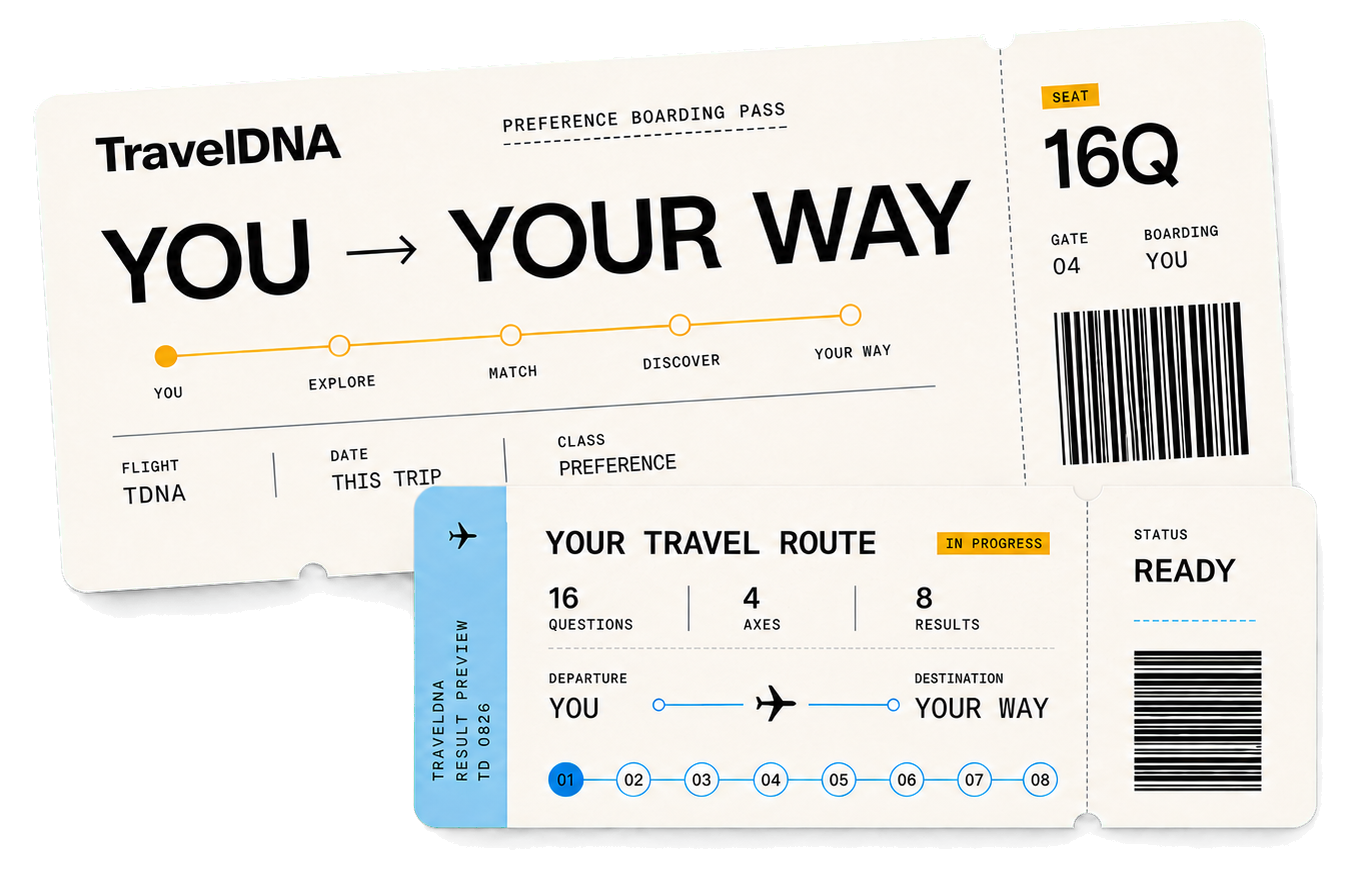
Every result includes a primary style, a secondary direction, four axis positions and a set of planning defaults. Dates, budget, mobility, food, accommodation and must-do places always take priority.
Visit fewer places in exchange for a fuller stay.
Travel profile · T06
Begin with two to four places a day and keep at least an hour of staying or recovery room around the main stop.
Each style has a city ticket, a complete profile and useful planning defaults. The city is a visual code, not a destination recommendation.
Lock in what cannot be missed, then leave an exit for change.
You prefer to settle intercity transport, high-demand reservations, closure days and each night's base before departure. You are open to change; you simply do not want an avoidable mistake to consume half a day.
Your best itinerary has a visible skeleton. Protect one or two priorities per day, group food and walks around them, and allow at least 30 minutes between meaningful transfers.
Your risk is filling every blank. Queues, fatigue and an unexpected favorite place will compete for the same afternoon. Dates, budget and the needs of your travel party always override the original plan.
Choose a direction; let the moment decide the detail.
A minute-by-minute itinerary makes you tired before the trip begins. You prefer to confirm the stay and a broad direction, then let conditions and new discoveries choose the next stop.
You still benefit from a few fixed points: accommodation, intercity travel, scarce tickets and anything you would regret missing. Give each half day one anchor and one block of unnamed time.
Spontaneity is most expensive around last trains, reservations and closure days. Ten minutes checking the day's one hard boundary gives the rest of the day more freedom.
See the side of the city that cannot be replaced.
On a first visit, you want to stand in front of the places that belong to this city alone. Missing the one that mattered can leave a gap even if the rest of the trip was comfortable.
Name no more than three places you would genuinely regret missing, then check opening times and geography. Protect one or two core landmarks per day and place food and recovery nearby.
Signature sights usually bring crowds and queues. Too many turn a city into a sequence of photos; budget, mobility and the travel party must decide which ones remain.
You would rather understand one neighborhood than rush through more coordinates.
You like a city after it settles into ordinary life. Markets, parks and small local places can feel more revealing than a chain of famous sights.
Plan by walking radius. Choose a neighborhood center, one meal, one long walk and a few optional stops; limit major cross-town moves to one or two a day.
Wandering without any checks can lead to an entire area being closed or a limited event being missed. One clear anchor per day is enough to protect what matters.
Connect your interests as far as the day can carry you.
You are good at seeing how a scattered wish list can become one route. Completing the things you came for gives the day a clear sense of momentum.
Start with four to six stops in one direction. Put the most physical or time-sensitive item in the morning and protect a seated recovery break of at least 45 minutes after lunch.
A queue, a wrong turn and a downpour can quietly become a lost evening. After two dense days, remove one cross-town transfer from the third.
Visit fewer places in exchange for a fuller stay.
You do not measure a trip by quantity. Looking twice at one work or walking the same street again can matter more than covering another district.
Begin with two to four stops a day and make one the main place. Leave about 60 minutes around it, and keep long-distance days to one faraway target.
Slow travel still has hard times: admission slots, closing hours and last transport. Write down the day's single non-negotiable time and keep the rest spacious.
You can travel with anyone, as long as you still hold your own rhythm.
You need part of the trip to be yours. Different wake-up times, eating pace or interests do not make separate plans awkward in your eyes.
Divide the itinerary into shared and independent sections. Keep joint bookings together, and define a meeting point, latest return time and backup contact for any split period.
Independence depends on transparent information. Shared costs, return transport and safety details must stay visible; reduce split time when someone needs care or night transport is uncertain.
What you experience together matters more than what each person completes.
You care whether an experience can be remembered together. You watch the group's energy while planning and consider everyone's needs when choosing where to eat.
Before the trip, ask each person for one must-do and one hard no. Protect the overlap, and use short separate blocks when interests genuinely diverge.
Your risk is automatic compromise. Saying anything is fine every time can hide frustration until late in the trip; silence should never be treated as consent.
TravelDNA describes how you prefer to approach this trip. It is not a psychological assessment and cannot replace real constraints. Dates, budget, companions, mobility and must-do places always come first.